📚LLM Wiki
An internal support tool: a self-maintaining knowledge base my AI sessions read before answering and update after building, so context compounds instead of resetting each time.
Product management is my craft; shipping is my proof. Everything below is a real, running system: designed, built, and operated end-to-end on my own infrastructure, AI-assisted and human-directed across a modern toolchain. No tutorials, no toy demos. Agent platforms, product concepts, native apps, and pipelines that run every day.
A closer look at a few. Click any screen to zoom.
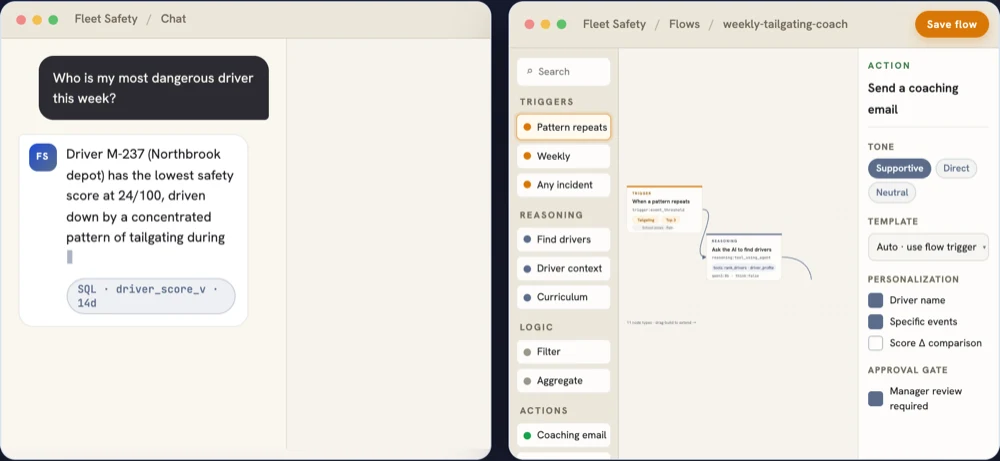
Fleet managers drown in dashcam events; insight arrives too late to coach anyone.
A driver-safety platform concept where managers chat with their fleet's event data and an autonomous flows engine runs scheduled coaching interventions: drafting coach emails, flagging fatigue patterns, and tracking whether interventions actually reduced events. Built on a strict "LLMs explain, tools compute" rule: every number comes from the database, never the model. Featured as a full case study on the main page.
Customer-success teams rebuild "what's happening with this account" in slides every single week.
A continuously-maintained, queryable account-state model: every meeting note, ticket, and status change flows into a living dossier, and any stakeholder can ask "what's really going on with account X?" and get a current, citation-backed answer. No deck reconstruction, no chasing reps.
Cloud-cost anomalies get investigated days late; autonomous agents nobody trusts get switched off.
An interactive product concept for bounded-autonomy FinOps: an agent investigates spend anomalies through an Observe → Investigate → Reason → Propose → Verify loop, but every action passes a permission envelope (Auto / Approve / Locked) and a customer-tunable ROI gate. Failed investigations stay on the ledger by design: trust comes from showing the misses.
Cloud LLM bills explode when every task, trivial or hard, goes to a frontier model.
A self-hosted multi-agent platform: a router classifies each incoming request and sends cheap work to local models and hard work to Claude, behind one streaming gateway with pluggable providers (claude-code / ollama / openai-compat). Runs my actual life through a Telegram interface: CV pipeline, finance tracking, market discovery, cron reports.
ChatGPT-class assistance for work that can never leave the machine.
A local-first desktop AI app: chat, vision, artifacts, document generation, and an agent-style tool belt, running entirely on local models. Zero tokens leave the machine; conversations, memory, and files stay on disk.
Product discovery that depends on manually trawling Reddit and HN doesn't scale past one topic.
A multi-topic discovery pipeline that scrapes community signals nightly, clusters them, and scores opportunities on three axes: Pain (40%), Scale (35%), Timing (25%). The twist: an LLM autotuner reviews each cycle's results and rewrites its own search queries and sources for the next one. Discovery that improves itself while I sleep, at $0/cycle on local models.
More from the lab, each one real and in use.
An internal support tool: a self-maintaining knowledge base my AI sessions read before answering and update after building, so context compounds instead of resetting each time.
A native iOS parenting app: log a child's positive moments and watch a reward garden grow. Shown in full on the main page.
Native macOS app that shows which process owns every listening port and which project it belongs to.
One click launches a grid of parallel Claude Code agents in tmux, each pointed at its own directory.
The household hub: one dashboard for cron reports, market discovery, image generation, and family spending.
A daily pipeline that reads my phone screenshots, recognizes AI tools with Claude vision, and catalogs them, then cleans up after itself.
Job description in, tailored CV out: 11 protected base facts, 12 tailoring rules, and a validator that rejects drift.
A paper-trading bot where bull and bear analyst agents debate every trade before a judge, risk panel, and portfolio manager sign off.
A 27K-line Claude Code skill encoding a full equities trading methodology, with backtest-to-live parity.
A local retrieval pipeline over personal documents: the predecessor whose lessons became the LLM Wiki.
Local FLUX.1 image generation wired into the dashboard: prompt → tuned workflow → gallery, no cloud.
Every two hours, a local model turns raw cron output into executive summaries with action items.
A deliberately tiny reverse proxy that exposes exactly two dashboard routes to my family over a Cloudflare tunnel. Everything else is a 403.
dor-pm.ai itself: served from a Mac mini through a Cloudflare tunnel with zero inbound ports, hardened headers, and custom-domain email.
"Diagram this repo" → a live, editable architecture canvas. A Claude Code plugin with its own MCP server.
The whole system answers in one chat: CV requests, budgets, market radar, cron status, streamed live.